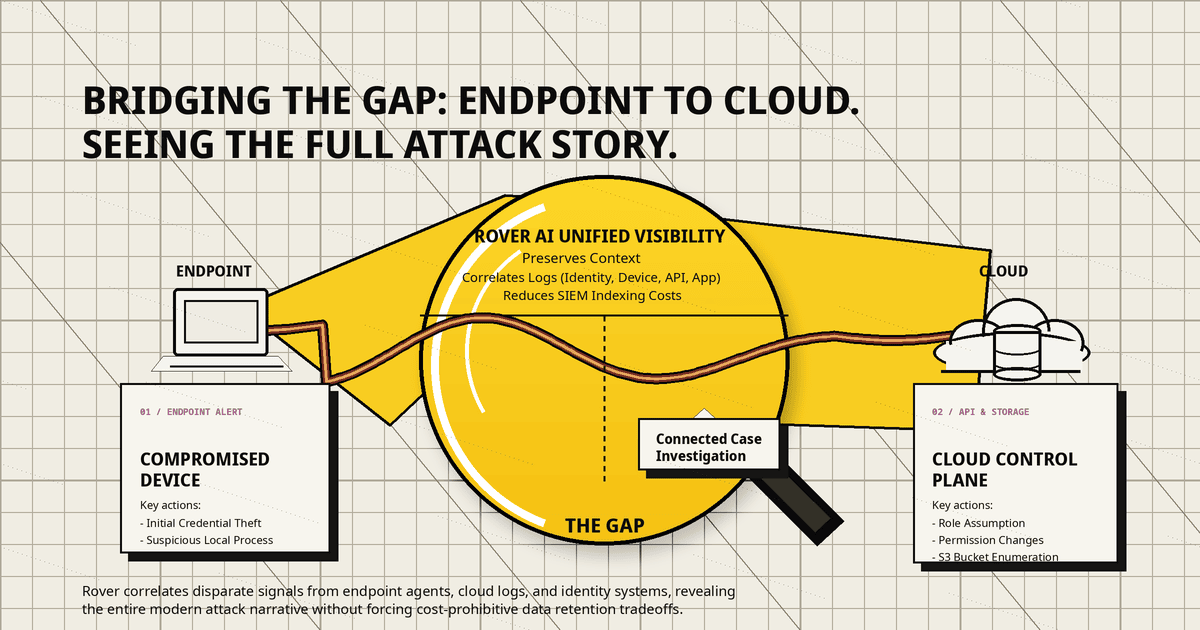
Modern attacks do not stay in one place.
An incident may begin with a compromised laptop, move through a browser session, steal a cloud token, assume an admin role, touch a storage bucket, and then trigger suspicious behavior on another workload. Endpoint tools may see the process. Cloud security tools may see the API call. Identity systems may see the login.
But the attack itself is not three separate incidents. It is one story.
That is the challenge security teams face today. Endpoint detection and cloud security have both matured, but they often still operate as separate lenses. Each tool sees an important part of the truth, leaving the analyst to connect the pieces under pressure.
In cloud-first environments, that gap is becoming harder to ignore.
Endpoint Detection is Necessary, but Incomplete
Endpoint Detection and Response (EDR) changed security operations by giving teams visibility into what happens on devices and workloads. Analysts can now see suspicious processes, command execution, persistence attempts, credential access, lateral movement, and user-device activity.
That visibility is critical, but the endpoint is often only the starting point.
A compromised developer workstation may not be the final target. It may simply be the place where an attacker steals credentials, session cookies, SSH keys, access tokens, or cloud configuration files. Once the attacker moves into the cloud control plane, the most important activity may no longer look like malware.
It may look like normal API activity:
- A new access key is created.
- A role is assumed.
- A security group is modified.
- A storage bucket is enumerated.
- A snapshot is shared.
- A workload is launched in an unusual region.
None of these actions live neatly inside the endpoint console. They belong to cloud audit trails, identity logs, infrastructure telemetry, and application data. Endpoint detection can tell you what happened on the machine, but it rarely explains what happened next.
Cloud Security is Powerful, but Needs Local Context
Cloud security tools are built to understand infrastructure, permissions, workloads, storage, network flows, and misconfigurations. They tell teams when an identity performs an unusual action, when a resource drifts from policy, or when a cloud environment exposes new risk.
However, cloud telemetry often lacks the local context needed to explain why something happened:
- Was the API call made by a legitimate automation job?
- Was it triggered from a developer's laptop after a suspicious process ran?
- Was the user already involved in an identity anomaly?
- Was the same device seen touching production systems minutes before the cloud action?
Without endpoint context, cloud events look ambiguous. Without cloud context, endpoint events look isolated.
This is exactly where attackers benefit. They do not need to defeat every detection layer; they only need to move between layers faster than the SOC can correlate them.
Traditional SIEMs Make This Harder Than it Should Be
The SIEM was supposed to be the place where signals came together. But for many teams, traditional SIEM architecture creates a new problem: cost.
Endpoint telemetry is high volume. Cloud audit logs are noisy. Identity, application, infrastructure, and SaaS logs continue to grow every year. In legacy SIEM models, keeping this data searchable often means paying an indexing tax.
- Every new source increases cost.
- Every extra gigabyte increases cost.
- Every longer retention window increases cost.
This creates a difficult tradeoff for security teams. They must choose between ingesting less data, reducing retention, pushing logs into cold storage, or paying significantly more to keep everything searchable.
When an incident happens, the missing context is often exactly what analysts need. A suspicious endpoint event today may only make sense when connected to a cloud API call from three weeks ago. A strange role assumption may only become clear when tied to an identity anomaly from last month. A quiet configuration change may be the missing link in a larger attack path.
If the data was dropped, archived, or priced out of reach, the SOC gets the alert but loses the story. Security teams should not have to choose between visibility and budget.
Rover AI Changes the Economics of Investigation
Rover AI is built for a different security reality.
Instead of forcing teams to choose between retention and budget, Rover changes the economics of security data. Teams can keep long-term telemetry available for investigation without carrying the massive indexing cost burden that comes with traditional SIEMs.
This matters because modern investigations require historical context. Attackers move slowly. Credentials may be stolen weeks before they are used, and cloud permissions may be changed quietly before data access begins. Endpoint activity, identity behavior, and cloud events may appear unrelated until they are viewed together over time.
Rover makes that long-term context available exactly when analysts need it.
By reducing the cost burden of retention and search, Rover helps teams preserve the evidence required to connect endpoint activity with cloud behavior. Analysts can investigate across sources without worrying that the data was too expensive to keep searchable, resulting in a complete picture of the attack.
Endpoint and Cloud Security Work Better Together
Endpoint detection tells teams what happened on the machine. Cloud security tells teams what happened in the control plane. Identity logs show who acted, while application and infrastructure data show what changed.
Individually, each layer is useful. Together, they reveal the full attack path.
As attacks move across devices, users, APIs, workloads, and cloud services, security teams need an investigation model that follows the attacker across those boundaries. They need to retain the data, search it affordably, and connect activity across endpoint and cloud environments.
Traditional SIEMs make that difficult because of indexing costs and retention tradeoffs. Rover AI removes that tradeoff.
With long-term retention at a fraction of the cost, Rover helps security teams keep the context they need to bridge the gap between endpoint detection and cloud security. Because the real advantage isn't collecting more alerts; it's keeping the context needed to understand the whole attack.
Do not let the full story price you out.
Ready to bridge the gap between endpoint and cloud security? Discover how Rover AI gives you the long-term context needed to trace modern attacks without the traditional SIEM price tag.