The cybersecurity industry is aggressively pushing toward autonomous SecOps, promising that AI agents will independently triage alerts, hunt threats, and build attack narratives at machine speed. But for security practitioners actually dealing with complex, multi-stage attacks, this promise is falling flat.
When deployed in the real world, these agents stall, hallucinate, or simply fail to connect the dots.
Why? Because the bottleneck in autonomous SecOps is not the reasoning capability of the AI; it is the fundamental flaw of the underlying data architecture. To understand why AI agents fail in the modern SOC, we have to look at the storage layer.
The Architectural Disconnect
For the last decade, security teams have been caught in a tug-of-war between two fundamentally different platforms, attempting to force one to do the job of the other.
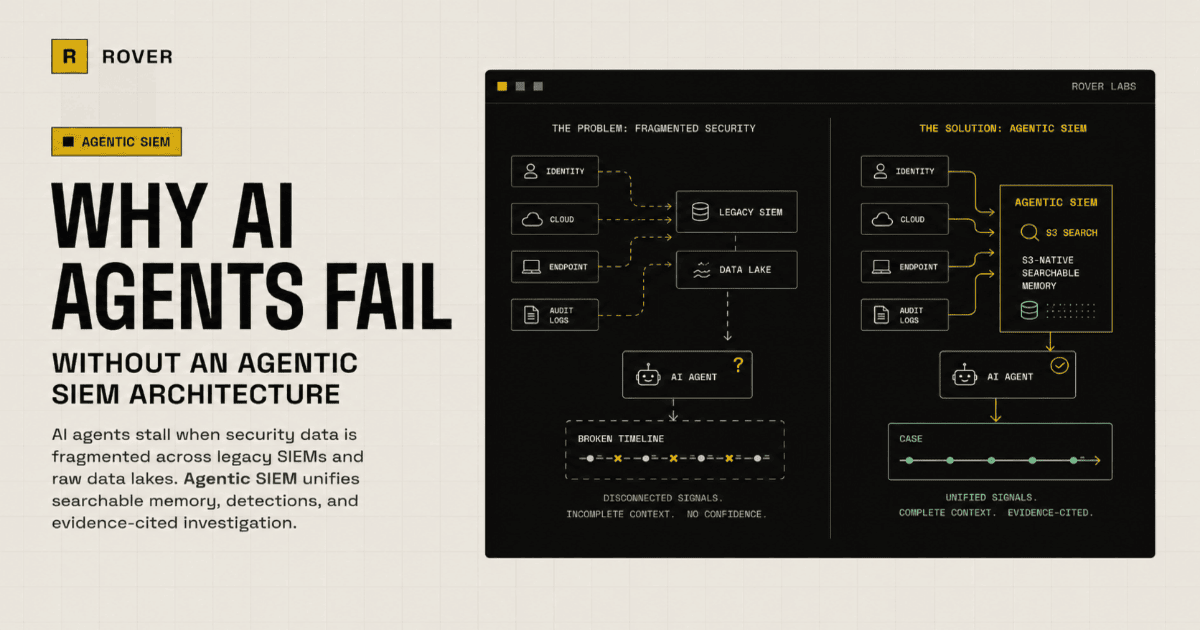
SIEMs are not data lakes. Legacy SIEMs were built with tightly coupled storage and compute. To search data quickly, it must be indexed in a highly optimized "hot tier." This makes limitless retention financially impossible. Security teams are forced into the struggle of choosing between telemetry and budget, dropping VPC flow logs, truncating EDR data, or reducing retention to 30 days just to keep their SIEM license intact.
Data lakes are not SIEMs. To escape the SIEM storage trap, many teams dump their long-term logs into a raw data lake, warehouse, or lakehouse. While this solves the retention cost, it strips away the security context. Data lakes lack out-of-the-box security parsers, entity mapping, and native case-management workflows.
The Dual Struggle: Humans and Agents
When you split your security posture across an expensive, short-term SIEM and a cheap, unstructured data lake, the investigation workflow breaks down for everyone involved.
The Human Struggle
Analysts are forced to pivot continuously. An alert fires in the SIEM, but the initial access vector happened 45 days ago and the logs have already "rolled off." The human analyst must pivot to the data lake, write complex SQL queries, wait for the slow search to finish, and then manually stitch the timeline back together. It is slow, fatiguing, and prone to error.
The AI Agent Struggle
Vendors are currently trying to solve this by dropping AI agents on top of these broken architectures, leading to inevitable failure:
- Agents in a legacy SIEM: An agent cannot investigate what it cannot see. If a legacy SIEM forced you to drop DNS logs or limit retention to 30 days, the AI agent has no historical data to build a complete attack timeline. The trail goes cold.
- Agents in a data lake: If you point an AI agent at petabytes of unstructured JSON in an S3 bucket without entity mapping or security context, it drowns. It does not know how to reliably group related signals, score severity, or quickly navigate the schemas required to reason about a multi-step attack.
The Solution: Rover is an Agentic SIEM
To make autonomous AI actually work in the SOC, you need an architecture that combines the economics of limitless cloud storage with the highly structured, natively parsed workflow of a security platform.
Rover is an Agentic SIEM built specifically to provide the foundation AI agents need to succeed. It eliminates the compromise between cost and visibility by restructuring how security data is handled:
- Index data directly in S3, where it already lives: Rover moves the searchable memory and indices directly to your S3 buckets. You get the limitless retention of a data lake, but the data is structured and entity-mapped for immediate agentic use.
- Run detections continuously on the full stream: Instead of waiting for batch jobs or relying solely on generic rules, Rover continuously evaluates the data stream against core, adaptive, and behavioral detection layers.
- Search years of data in seconds: Because the data in S3 is natively indexed for security, Rover's AI agents and your human analysts can instantly query massive historical datasets without the cost penalty of a hot tier.
Instead of human analysts pivoting between platforms to run manual queries, Rover agents autonomously execute the investigative workflow. When a detection fires, the agent queries the S3 indices in seconds, collects years of historical evidence across identity, cloud, and endpoint, and links the signals into one cohesive, cited attack narrative.
Rover eliminates the choice between telemetry and budget. It gives AI agents the limitless, structured historical data they need to build the narrative, and gives human analysts the clear, proven timeline they need to respond.